Developing your own battery test system. It’s a common path for teams who need maximum flexibility and control. However, from years of experience we also know this path is often filled with unforeseen risks to your schedule, budget, and final performance.
The core challenge lies with the power supply. Most battery test suppliers rely on monolithic, conventional power supplies. These units have a rigid, square output, meaning you only get maximum power at the maximum voltage. This forces you to over-purchase and over-provision for every potential test case, leading to wasted capacity, space, and money. Scaling up is difficult, if not impossible.
Before you commit to the significant engineering effort of a ground-up build, I want to propose a fundamentally different, more strategic approach.
Stop Building from Scratch. Start Building with Smarter Blocks.
Imagine having a set of universal, LEGO-like power building blocks that could be configured for any test scenario you have today, or any you might dream up tomorrow. That is what we offer with the combined power of Tektronix and Elektro-Automatik (EA).
Instead of locking you into a proprietary, dead-end system, we provide two flexible paths to success, both built on the most advanced power platform in the industry:
Path 1: The Fully Integrated, Turnkey System
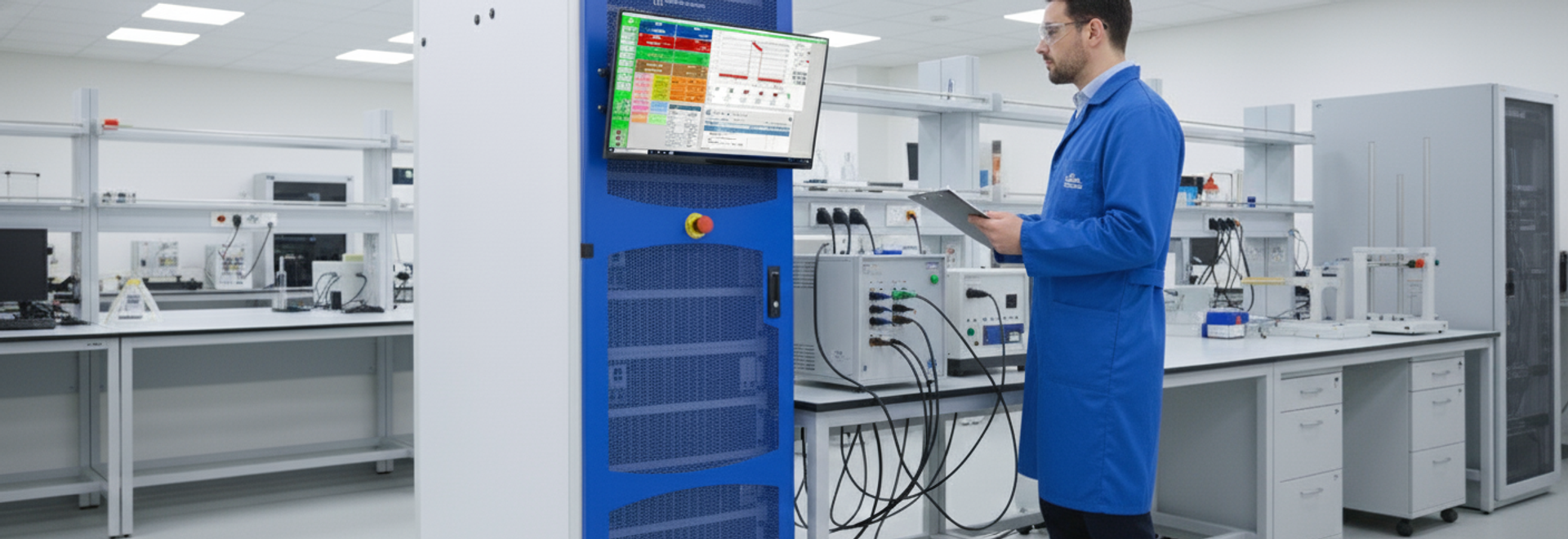
Let our experts do the heavy lifting. We can design and deliver a complete, integrated test system tailored specifically to your requirements, including seamless integration with your ISOspy BMS and battery interfaces. This is your fastest, lowest-risk path to a reliable, high-performance testing solution.
Path 2: Build Your Own System, Better.
Use our EA 10000, 20000, or 30000 series of bidirectional power supplies and regenerative loads as the core of your system. You retain full control and flexibility, but you eliminate the biggest risks associated with a custom build. You're not building a power system; you're simply assembling one with proven, world-class components.
The EA Advantage: Why Our "LEGOs" are Better
No matter which path you choose, you get the same foundational advantages that make a traditional "build-your-own" approach obsolete:
- True Autoranging Power: This is our game-changer. Unlike the restrictive "square output" of competitors, EA power supplies deliver maximum power at any voltage down to 33% of the unit's maximum. One EA supply can do the work of multiple conventional units, covering a massive range of test parameters without ever being underutilized.
- Unmatched Scalability: Need more power? Add another block. Need higher voltage? Configure them in series. Our power modules, ranging from 1.5 kW to over 60 kW in a single chassis, are designed for this "building block" approach. You can create a system that perfectly matches your needs today and easily scales to megawatts for the future.
- Open, Non-Proprietary Control: We believe you should choose the best software for your needs, not be forced to use ours. Our systems are built with open, non-proprietary software and a vast library of communication interfaces (CAN, Ethernet, etc.), giving you the freedom to integrate and automate as you see fit.
Building a test system is a critical investment. The risk of relying on inflexible, monolithic power supplies or underestimating the complexity of a ground-up build can jeopardize your entire project.
By partnering with Tektronix/EA and W5 Engineering as extension of your engineering team and/or strategic Battery Test integration partner, Blue Origin can mitigate those risks.
You leverage our decades of power expertise, allowing your team to focus on what they do best: developing and testing world-class launch vehicles.
We would welcome the opportunity to schedule a brief on-site meeting to discuss your specific requirements and demonstrate how these "building blocks" can significantly accelerate your timeline and reduce your overall cost.
PS. If you’re weighing battery test platforms, here’s why W5 Engineering (and many others) choose EA Elektro-Automatik with Tektronix over Keysight, Chroma, Lambda-TDK, ITECH, Ametek, or APS:
One EA supply covers much wider range of operating envelope. EA’s true auto-ranging designs deliver full power across a wider Voltage and Current window — that means fewer boxes, more flexibility.
Flexible like LEGOs. Only EA can mix 5 kW, 15 kW, 30 kW, and 60 kW modules in one or even racks. Where as all other suppliers require both the Max Power and Max Voltage levels be identical for each building block. Effectively that means you have to double the power levels in order to parallel or series connect competitive suppliers. And only EA has software and FPGA hardware-based networking between supplies that eliminate modulation, ripple and noise issues that have plagued less sophisticated designs. But with W5 Engineering and EA, our modular, pre-built racks mean customers can build systems with unprecedented power granularity and scalability. So you can build exactly the Power you need today in large or small increments — and expand later without forklift upgrades.
So, you get a smaller footprint = lower cost and a future proof design. Up to 30 kW in 4U or 60 kW in 6U, that can be scaled to MW-class, or even repurposed back into individual power supplies! That means less manufacturing floorspace, higher density around test chambers, and faster installs.
One box = source + load. Bidirectional, regenerative (>96% efficiency). Quieter labs, far less HVAC demand, and energy sent back to your facility or the grid.
Battery-specific testers.
- BT-20000: Triple-output (3×10 kW), ±600 A/channel, built-in comms. 55-sec demo
- BTS-10300: 300 kW in 6.5 ft², scalable to MW. Widget-based GUI integrates chambers + BMS. System overview
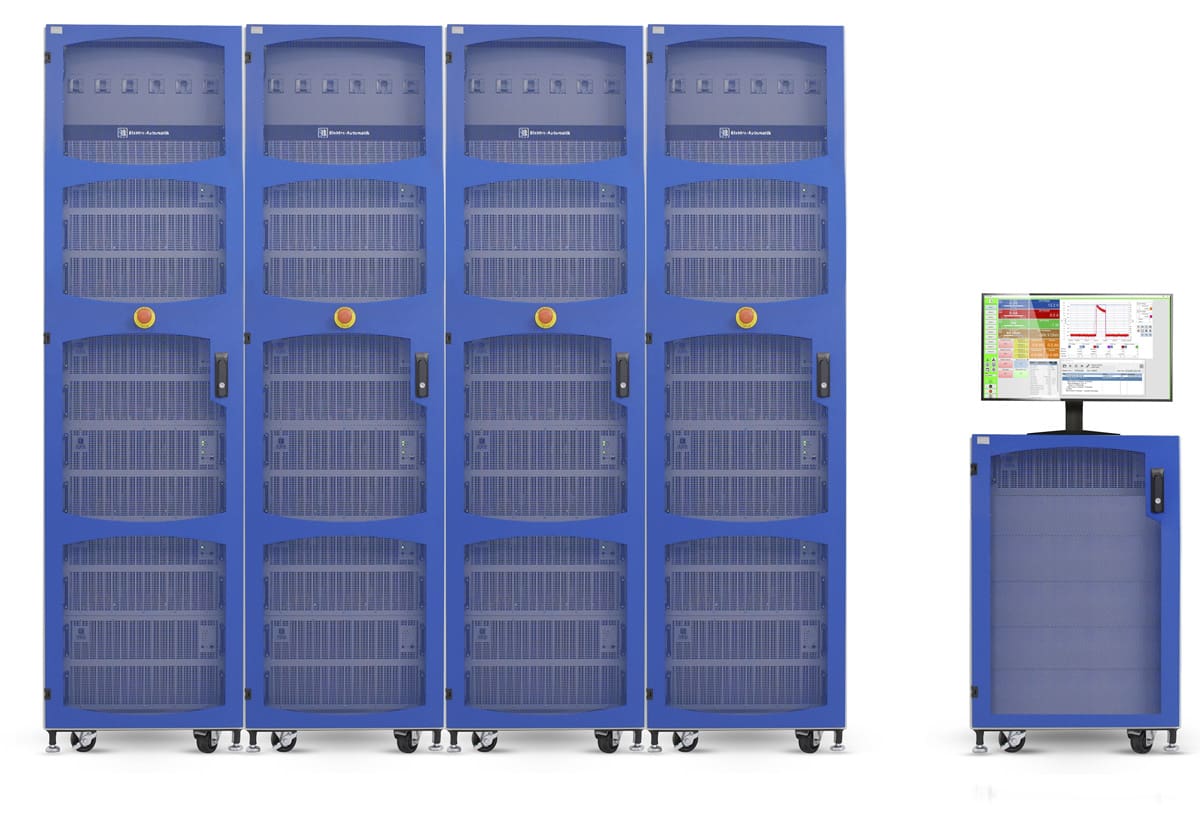
One software surface. Same commands (SCPI/ModBus/LabVIEW/IVI) across the line. Learn once, scale everywhere.
Lower risk. Fast delivery (~7 weeks), U.S. service, and Tektronix/W5 integration means fewer boxes, less wiring, shorter debug — and programs that stay on schedule.
In short: EA is a platform, not just hardware. Flexible like LEGOs, dense in footprint, and regenerative by design — backed by Tektronix + W5. It reduces cost, risk, and complexity while giving you room to grow.
Contact W5 Engineering to map your DUT envelopes and show how one EA stack replaces legacy-designs of our monolithic competitors. Oh, BTW, when their box fails the power output is zero, And you are down until service can be performed on site or shipped back to the factory. With an Elektro-Automatic based system, the System will auto-reconfigure to an N - 1 design giving you full output power of the remaining modules!